Let’s create the “Wynn-Williams Effect”
From the How-to-make-bad-behavior-self-defeating Department

Sarah Wynn-Williams was a senior executive at Facebook. (You’ll remember, midway through the media storm created by Frances Haugen’s whistleblowing, Facebook changed its name to Meta, no doubt hoping that might change the story as well. Whatever. In this story, I’m going to stick with “Facebook.”) In 2025, Wynn-Williams published a book about her experiences at Facebook. Careless People tells a story about that company that is worse than even I expected. I had had some exposure to what went on. I was helping Haugen when she became the “Facebook Whistleblower,” and spent endless hours reading through the Facebook Files. But Wynn-Williams’ experience was closer to the top. And the story she paints is astonishingly depressing. If you ever need to be convinced that the future of humanity should not rest with the judgment (or integrity) of Silicon Valley executives, this book is a must read.
When Haugen went public, there was a significant fear that Facebook would use the law to punish her. But when she wowed Congress, they wisely chose not to. Or at least, wisely, from the perspective of free speech and democratic values. Society desperately needs whistleblowers, especially among unregulated technology companies radically affecting social and democratic life. Without them, we would have no understanding of either the choices those companies make or the consequences of those choices for all of us.
Wynn-Williams’ going public, however, didn’t trigger the same non-reaction from Facebook. Instead, Facebook has aggressively litigated to silence her and suppress her book — now even comically so. As described by another critical social media whistleblower, Carole Cadwalladr, when Wynn-Williams was invited to the Hay Festival, her lawyer had to instruct the festival organizers about the risks in her appearing. As the lawyers wrote, Facebook
“has obtained a temporary order preventing Ms. Wynn-Williams from ‘promoting’ her book or speaking about certain topics, regardless of whether what she says is true. As a result, while we continue to challenge that order, Ms. Wynn-Williams has been careful not to speak about her book or about [Facebook] during her public appearances.”
I include the full letter below. But my point in writing this essay is a bit different.
Regardless of the underlying merits of the lawsuit Facebook has brought against Wynn-Williams — a lawsuit charging she has breached her agreement with Facebook—it is, in my view, wrong to use the courts (even arbitration courts) to order her to shut up.
Yet whether right or wrong, so long as courts (or activist arbitrators) are willing to issue such orders, companies like Facebook will be tempted to ask for them.
So what we need to do is to make such requests self-defeating.
Activist arbitrators (and courts) may well have the power to issue orders to Wynn-Williams to tell her she can’t promote her book. But they can’t order me — or you—not to promote her book. And if such improper orders triggered 10,000 others to promote her book in response, such orders would become self-defeating.
So inspired by the Streisand Effect, let us launch the Wynn-Williams Effect:
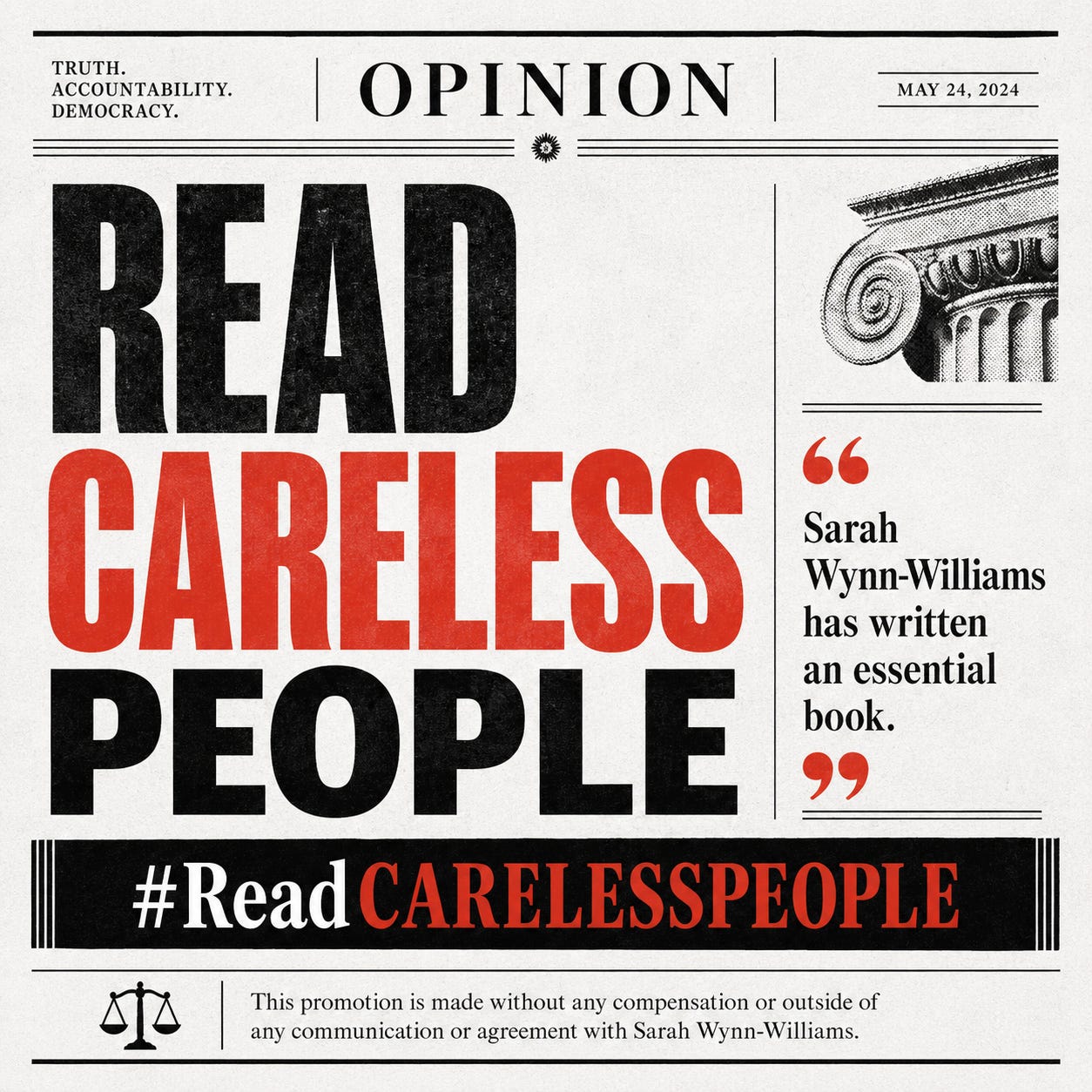
If a whistleblower is ordered by a court or arbitrator not to discuss or promote or explain a published work, then we all should discuss and promote and explain that published work for her. At least, any of us not employed by or profiting from that promotion.
I am not employed by Wynn-Williams. I am not profiting from this promotion. But having read the book and having spent endless hours with Silicon Valley whistleblowers, I am happy to promote the book here and anywhere I can.
You should read the book. You should share the book. You should make sure that every truth Facebook wants to hide in this book is understood by every thinking adult in every country Facebook has an effect. (i.e., Earth.)
Bad behavior should not be costless. Facebook, through its lawyers, is engaging in very bad behavior. Let’s raise the cost of that bad behavior.
(And do feel free to use these ChatGPT created images to help spice up your post!)

Letter from Sarah Wynn-Williams’s lawyers to Hay
May 30, 2026
Via E-mail
To: Hay Festival Foundation Ltd.
Re: Sarah Wynn-Williams Appearance
Dear Hay Festival Foundation:
I write on behalf of my client, Sarah Wynn-Williams, seeking your assistance in relation to her appearance at the Hay Festival this weekend.
As you may know, in March 2025, Meta initiated an emergency arbitration against Ms. Wynn-Williams and her publishers, demanding an order blocking publication of her memoir, Careless People: A Cautionary Tale of Power, Greed, and Lost Idealism.
Through that process, Meta has obtained a temporary order preventing Ms. Wynn-Williams from “promoting” her book or speaking about certain topics, regardless of whether what she says is true. As a result, while we continue to challenge that order, Ms. Wynn-Williams has been careful not to speak about her book or about Meta during her public appearances.
Despite Ms. Wynn-Williams’s caution, Meta has threatened her with further sanctions. In March 2026, Meta filed a sanctions motion claiming that Ms. Wynn-Williams violates the order any time she appears in public in a place where she should know that her book is available for sale and her presence might draw attention to it e.g. a bookstore.
Meta’s motion expressly identified her forthcoming appearance at the Hay Festival as an example of conduct that should be formally sanctioned. Meta based this assertion in part on Ms. Wynn-Williams’s planned appearance with Carole Cadwalladr, who Meta called “the British investigative journalist primarily known for her negative coverage of [Meta]” and with the academic Tim Wu, who Meta described as “another known critic.” Meta also said attending the Hay Festival would violate the order because the Hay Festival’s “promotional materials include a direct link to ‘Browse the Festival Bookshop,’ … which offers Careless People for sale.”
On Ms. Wynn-Williams’s behalf, we have vigorously disputed Meta’s characterization of her appearances, including her planned appearance at the Hay Festival, as a violation of the arbitrator’s order. We have also challenged that order as an improper prior restraint on Ms. Wynn-Williams’s freedom of speech. Nevertheless, the arbitrator has refused to lift the temporary order and cautioned Ms. Wynn-Williams that she may violate the order if she speaks at any event where she knows or should know that her book will be available for sale or where her presence there will likely encourage sales.
To ensure that Ms. Wynn-Williams can appear at the Hay Festival consistent with the temporary order, we therefore request you take all reasonable steps to ensure that Careless People is not sold at or through any festival bookshop, book-signing schedule, point-of-sale mechanism, or online link through which sales could be attributed to Ms. Wynn-Williams’s appearance at the festival.
To be clear: we do not make this request because we believe Meta has any legitimate basis to silence Ms. Wynn-Williams or control the actions of the organizers of the Hay Festival. We make it because we believe Meta has will exploit any pretext to further target Ms. Wynn-Williams and because the arbitrator’s interpretation of the temporary order, which we believe is vague and unworkable, creates the risk that, absent her taking reasonable steps to dissociate herself from any actions to promote sales of her book by third parties at the Hay Festival, Meta will succeed in its goal of silencing Ms. Wynn-Williams entirely.
I am available via the phone and email address listed above if you would like to discuss this further. Thank you for your consideration of this matter.
Sincerely,
Counsel for Sarah Wynn-Williams
Using the Streisand Effect is a great way to oppose the powerful using “legal process” to silence people. Courts of law are not the only way to get some semblance of justice. The other two courts are the “Court of Public Opinion” (aka the Streisand Effect) and the “Court of the Market”. Both of these alternative courts should be used whenever possible to rein in the powerful.
An example of the Court of the Market is the FDIV bug in the Intel Pentium processor.
An October 30, 1994 email to various academic contacts by Professor Thomas Nicely about the bug when Intel would not fix the problem for him caused the following result. [Search FDIV Bug on Wikipedia].
“The growing dissatisfaction with Intel's response led to the company offering to replace all flawed Pentium processors on request on December 20. On January 17, 1995, Intel announced a pre-tax charge of $475 million against earnings, ostensibly the total cost associated with replacement of the flawed processors.This is equivalent to $891 million in 2024.”
Judgment in 51 days and damages determined 28 days later. No lawyers involved. No litigation costs.
We have the power when we stop fighting ourselves to hold the powerful to account. We need to aggressively use this power now because the wealthy and corrupt are very close to nullifying all of the courts that protect us.