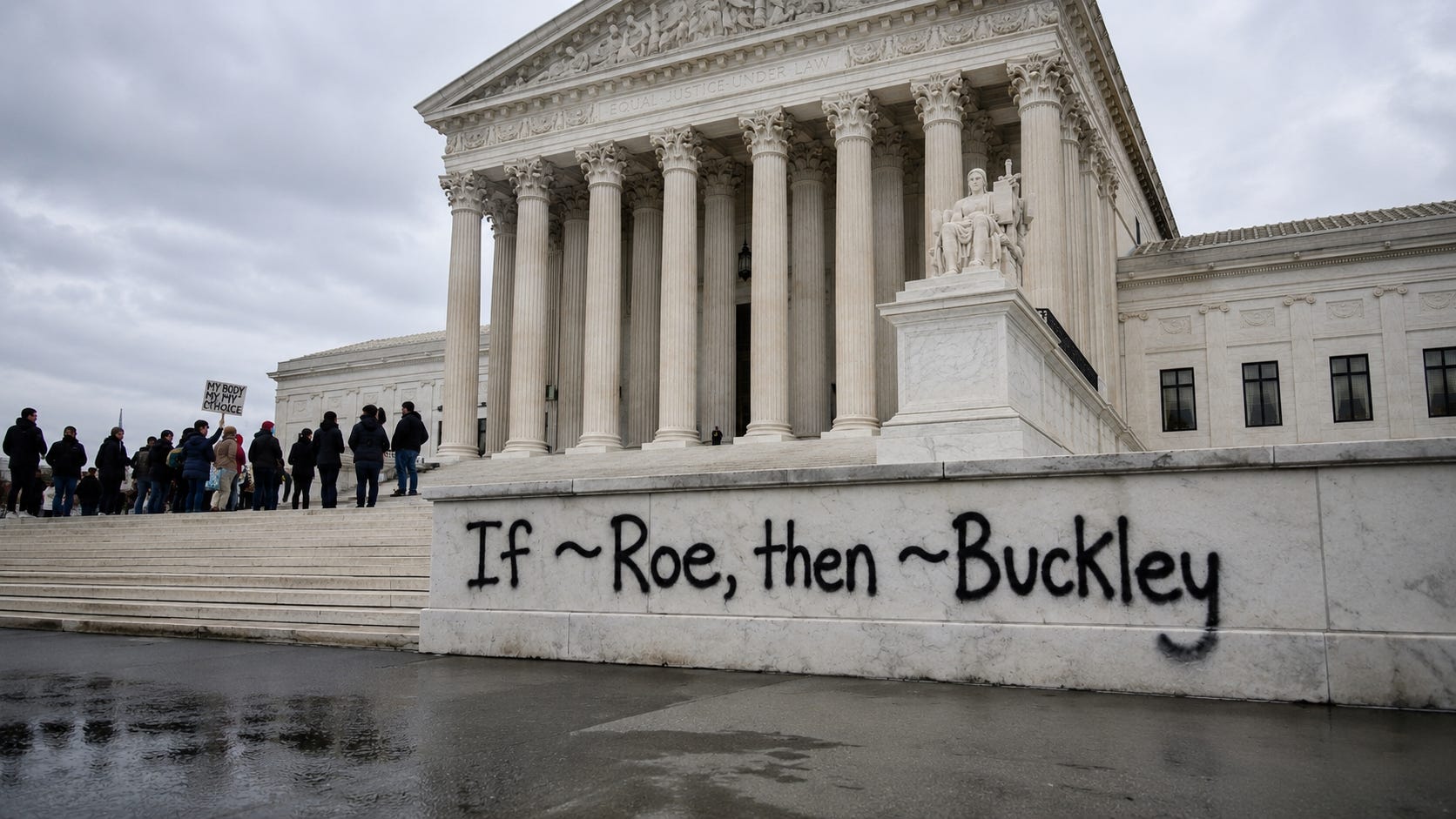
If ~Roe, then ~Buckley
Reaping what originalism has sown.

Almost exactly 20 years ago, a brilliant young social activist and technologist convinced me to give up my work on the Internet and copyright and to take up a fight against corruption. Aaron Swartz, who at the age of 13 helped craft RSS, and by the time he was persuading me, had co-founded Reddit and would go on to co-found at least two progressive reform organizations, asked me why I thought I could achieve the policy reform I sought “so long as we had this corrupt institution of Congress.” “It’s not my field, Aaron,” I told him. “You mean as an academic?” “Yes, as an academic,” I replied, “it’s not my field. I study copyright and internet policy.” “What about as a citizen?” he asked. “Is it your field as a citizen?”
He had trapped me. I had tenure. I could work on whatever I thought was important. And I knew he was right. That night, I resolved to give up on copyright and the internet. That summer, I announced the change. And for the last twenty years, I have done everything I could to push this issue to the center of America’s political imagination, writing books, starting at least three reform organizations focused on the issue, starting a SuperPAC to end SuperPACs, and trying to enter the 2016 Democratic primary for President focused exclusively on this issue.
Twenty years later, because of the work of many activists and reform organizations, as well as the sins of many politicians, America has caught up to where Aaron was twenty years ago.
In a study conducted by the Brennan Center for Justice released just last week, overwhelming majorities of Americans from all political perspectives identify corruption as a core political issue. 92% of Americans are either somewhat or very concerned “about corruption influencing U.S. elected officials.” Two-thirds see corruption as “deeply embedded in the institutions of the U.S. government.” A strong majority (55%) believe service in government makes elected officials corrupt. And 88% believe what Aaron had said to me: that this corruption is responsible for the problems our government has failed to solve.
Yet what’s striking about the public’s view of corruption is how far removed it is from the Supreme Court’s conception of corruption. 94% of those surveyed viewed the government’s prioritizing the interests of billionaires as “corrupt.” 89% view billionaires and big corporations having “an easier time having their voices heard” as “corrupt.” But from the Supreme Court’s perspective, neither is “corruption.” From the Supreme Court’s perspective, the only “corruption” Congress has the power to address — at least through means that limit the role of money in politics — is “quid pro quo,” or “this for that” corruption. Bribery is corruption. But the overwhelming influence of the superwealthy is just the way democracy is meant to work.
The Supreme Court grounds its limited view of “corruption” in its interpretation of the First Amendment. That amendment forbids Congress from “abridging the freedom of speech.” If Congress limits money in elections, the Court first said in Buckley v. Valeo (1976), that is an “abridgment” of “the freedom of speech” — unless that money creates a risk of quid pro quo corruption.
Yet it was never clear in Buckley from where the Court derived this view. The Court never explained the original meaning of the First Amendment; it never accounted for its decision to limit Congress’ ability to police the integrity of the political system to the regulation of its narrow view of “corruption.” Instead, the Court simply asserted that this would be the meaning of the framers’ First Amendment, even though, as Justice Thomas has acknowledged while essaying to overturn New York Times v. Sullivan, the framers of the First Amendment meant for Congress to craft the contours of the “freedom of speech,” and certainly never meant for the Court to second guess Congress’ crafting.
This gap between the original meaning of the First Amendment and the Supreme Court’s rendering of that meaning was not surprising in 1976. The Burger Court was not much concerned with the original meaning of the Constitution. That was part of what motivated the current Court to reverse another Burger Court decision, Roe v. Wade. And so it’s surprising that this Court — even the originalists on this Court — continue to block the ability of the people’s representatives to address the problem of corruption where the people’s conception of corruption does not accord with Buckley’s narrow definition. By what right? If we the people in fact never did enact a constitution or an amendment to that constitution that embraced the Supreme Court’s conception, by what authority does the Supreme Court interfere with the people’s view?
The answer — at least for an originalist — is by no right. And while not every justice on the Supreme Court declares themselves to be an originalist, a clear majority of the Court does, and the three who don’t would affirm a conception of “corruption” closer to the view of 92% of Americans than the conception in Buckley.
For the cynical, none of this is surprising. Many view the Supreme Court in partisan terms. By the time we lost him to suicide, that was Aaron’s view as well. For the cynical, to follow originalism to uphold Evangelical Christian values (Dobbs) while ignoring originalism when it comes to the power of the rich (Buckley, Citizens United) is no real surprise.
I don’t believe the Court is a partisan institution. I instead believe that it has simply not yet worked out what a consistent position for its newfound originalist majority should be. And when it finally gets around to considering that question in the context of campaign finance, it will recognize its inconsistency. The question then will be what it will do.
James Madison, the author of the First Amendment, promised us a Congress “dependent on the people alone,” where by the people, he meant, “not the rich more than the poor.” That his words have been read to produce a government plainly “dependent on” the rich more than the poor is not on him. It is the product of a Court unconstrained by the original meaning of his First Amendment. Whether this Court will remain so unconstrained — whether it will continue to impose its values on the Constitution’s text regardless of the meaning the framers gave to that text—is the most urgent constitutional question on the Supreme Court’s docket.
Thank you, Mr Lessig.
It is urgent that we work on the question you frame for us: "James Madison, the author of the First Amendment, promised us a Congress “dependent on the people alone,” where by the people, he meant, “not the rich more than the poor.” That his words have been read to produce a government plainly “dependent on” the rich more than the poor is not on him. It is the product of a Court unconstrained by the original meaning of his First Amendment. Whether this Court will remain so unconstrained — whether it will continue to impose its values on the Constitution’s text regardless of the meaning the framers gave to that text—is the most urgent constitutional question on the Supreme Court’s docket."
Thank you for remembering Mr Aaron Swartz and reminding us of some of his many contributions.