"If not now, when?"
On the First Circuit argument to uphold the Maine initiative that could end Super PACs

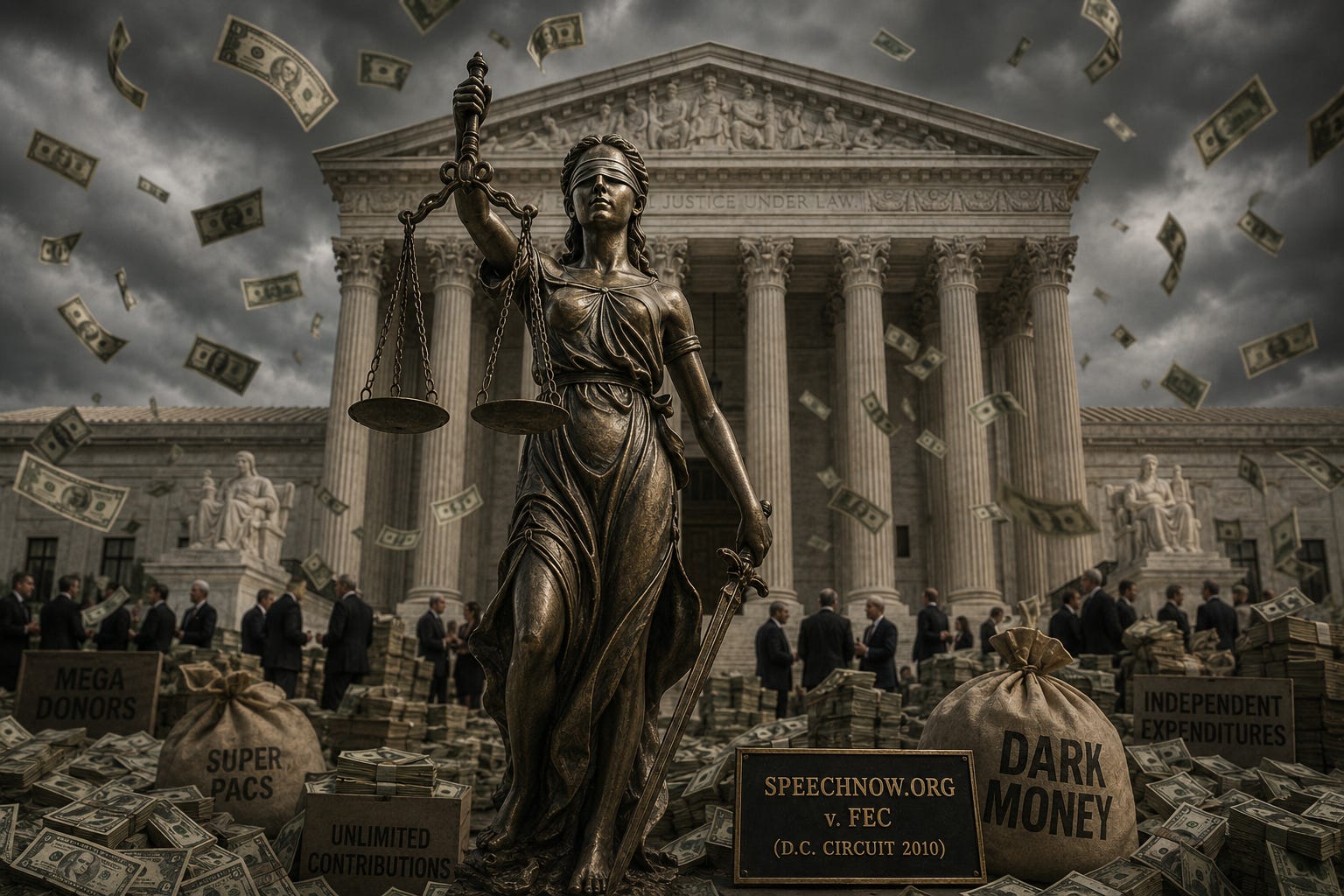
In 1896, the United States Supreme Court court-splained America about just what segregation meant. Laws mandating the separation of the races, the Supreme Court told us in Plessy v. Ferguson, “do not necessarily imply the inferiority of either race to the other.” And if African Americans understood them differently, that was “not by reason of anything found in the act, but solely because the colored race chooses to put that construction upon it.” Forcing Black people to sit separately from White people had nothing to do with inequality. Both races were disabled from mixing with the other — equally.
What’s astonishing about that holding is not that that Supreme Court made it. What’s astonishing is how often its conclusions were repeated as if they were principles of logic penned by the Almighty himself. The Kansas Supreme Court, seven years later, wrote about schools, “The principle of equality is in no wise violated by the establishment of separate race schools.” The same holding is repeated endlessly across the nation. And not just by the judges. Criticizing the decision that reversed Plessy, one of America’s leading law professors, Herbert Wechsler, quoted Plessy’s “chooses to put that construction upon it” language and then asked, “Is there not a point” to it?
But it took another (and greater) law professor to put the whole debate into its proper context. Responding to Wechsler’s question the following year, Yale law professor Charles Black invoked “one of the sovereign prerogatives of philosophers—that of laughter.” It was absurd, Black insisted, to require that courts “refuse to note a plain fact about the society of the United States—the fact that the social meaning of segregation is … inferiority.”
“Must a court,” he asked, almost pleadingly, “pretend not to know?”
Sixty-five years later, to quote an even better philosopher than Charles Black, Yogi Berra, “it’s like deja vu all over again.” This time, it’s not about the profound immorality of racism, but the astonishing explosion of corruption within our government.
Sixteen years ago, in a case whose infamy rivals Plessy, Citizens United v. FEC, the United States Supreme Court declared that independent expenditures “do not corrupt or create the appearance of corruption.” Three months after that decision, a lower federal court extended its reasoning to conclude that contributions to committees that made independent expenditures also did not corrupt or create the appearance of corruption. And thus neither expenditures nor contributions, these two cases together held, could ever be limited by state or federal law. “Freedom of speech” depended upon billionaires being constitutionally entitled to dump billions into our election system. When Citizens United was decided, as the New York Times calculated, billionaires constituted just 0.3% of outside spending; by 2024, they accounted for 19%, a 63-fold increase.
The tragedy (for the Supreme Court, at least) is that Citizens United may well be not the worst, but the most misunderstood opinion in its history. Justice Kennedy’s holding that “independent expenditures do not corrupt or create the appearance of corruption” was not wrong in the way Plessy had been wrong. For Kennedy was not reporting an empirical fact. Indeed, the record in that case had no evidence about actual or apparent corruption from independent expenditures. And Kennedy was explaining something subtle but important about the logic of the foundational case in campaign finance jurisprudence, Buckley v. Valeo (1976). It was Buckley that had held that the only basis for regulating political speech was the risk of “quid pro quo” corruption. And it was Buckley that had reasoned that if spending was “independent”—meaning the speaker and the candidate did not coordinate—then there was no risk of quid pro quo corruption. Why, as any sane soul would ask, would anyone expect that they wouldn’t coordinate? Because, not stated by Kennedy expressly but affirmed by his citation to Buckley, if they did coordinate, then the law converted the spending into a contribution. And a $10 million contribution is a crime. Thus, more completely, what Kennedy was actually saying was, “If everyone follows the law, then independent expenditures do not corrupt or create the appearance of corruption.”
That statement is literally true. What wasn’t true is what the D.C. Circuit did with it 3 months later. In SpeechNow v. FEC, Judge Sentelle reasoned that if an independent expenditure couldn’t corrupt or create the appearance of corruption, then it followed as a matter of logic that a contribution to a committee that made an independent expenditure also could not corrupt or create the appearance of corruption.
That inference was an obvious (once you see it) logical mistake. Citizens United was about the relationship between a speaker and a candidate; it depended on the regulations that limited the ability of both to “coordinate.” But the question in SpeechNow had nothing to do with speaker-candidate coordination. SpeechNow was about donor-candidate coordination. And nothing in federal law forbade a donor from coordinating with a candidate, even if a speaker or committee could not.
Nonetheless, in the 3 years after SpeechNow, five other circuits repeated the same logical mistake: contributions to committees that make independent expenditures, these courts held, cannot corrupt or create the appearance of corruption. And thus from this mistake was the Super PAC born, and again and again have judges (and lawyers) insisted that “contributions to committees that make independent expenditures do not corrupt or create the appearance of corruption”—a statement that, like “segregation is not about white supremacy,” boggles the mind in its obliviousness.
Until July 15, 2025, when finally, and for the first time, a federal District Court (magistrate) judge acknowledged what practically every American knew in their bones: that, in fact, contributions to independent political action committees do corrupt and create the appearance of corruption. And yet even here, the federal court held that because of Citizens United, there was nothing that could be done about that corruption.
The case was a challenge to an initiative enacted by the people of Maine in the 2024 election with a 74.9% vote. More people voted for that initiative than have voted for any initiative or person in Maine’s history. And yet, according to the judge, all that was irrelevant. The people of Maine had no freedom to stop the corruption of Super PACs. And if you ask any moderately well-trained lawyer, they will tell you that’s because “contributions to Super PACs cannot corrupt or create the appearance of corruption.”
If it is the sovereign right of philosophers to laugh, it is certainly the sovereign right of citizens to cry. Because this slogan is an obvious absurdity. And while it would be absurd at any time, it is especially absurd just now. We have never lived with a system of such open corruption as America suffers now—a corruption that depends fundamentally upon Super PACs to make it possible. This is why the Brennan Center could find that over 90% of Americans now view the political system as “corrupt.” How could there ever be a moment when the “appearance of corruption” was greater than when 90% of Americans believe it?
Three federal judges now have the chance to declare that the emperor of our political moment, Super PACs, is wearing no clothes. Last week, judges in the First Circuit Court of Appeals heard arguments about the Maine initiative. Both the lawyer representing the state of Maine and Neal Katyal, representing interveners, worked to get the Court to acknowledge what every sane soul in America already knows: that the system of Super PACs has corrupted American politics, and that nothing in Citizens United—let alone Madison’s First Amendment—blocks the people of Maine from ending them.
I have seen many oral arguments in my career. I have rarely seen one in which the judges were as well prepared: they knew this case cold. And I have never seen a better oral argument than the one presented by Neal Katyal. (You can listen here; be sure to listen at the end to the closing.)
If these judges have the courage to utter what everyone knows is true, then the United States Supreme Court will have the chance—finally—to correct the misinterpretation of Justice Kennedy’s least-liked, most-misunderstood opinion and end the corruption of Super PACs.
Every judge fears reversal by a higher court. And no doubt, these three judges fear the same. But as against the reality of the current moment, how does that fear compare? The corruption of Richard Nixon was nothing as compared to the corruption of today. If the Supreme Court was willing to uphold (in critical parts at least) the most important campaign finance regulation in America’s history because of Nixon’s abuses, then certainly the far more systemic and profound abuses of the moment must justify this most measured response: not to deny the rich the right to speak (because Citizens United and Buckley preserve that absolutely), but to allow the people of Maine to block the committees that enable this corruption to fester and to keep it from spreading throughout our republic.
Katyal ended his argument by remixing Hillel: “If not now, when? If not on this record, what record are we going to need?” His question was apt. Because if the First Circuit does not at least tee up the core question that has haunted this field since SpeechNow—namely, whether there is any substantial governmental interest in limiting the size of contributions to a committee that is independent of a candidate or her committee—then there is literally likely no other path to get to the Supreme Court. Eight circuits have now ruled on this question. Only the 3rd, 6th, and 11th remain beyond the 1st. And in those, only the 6th and 11th have states that permit citizen initiatives. So sure, let’s get an initiative in Ohio and Florida. I’m sure the proposal would win there too. But the shortest path to correcting this obvious error would be for the First Circuit to frame a very narrow holding grounded in the logic of Citizens United—ideally buttressed as well by recognizing that never has the Court considered an originalist argument in the context of campaign finance jurisprudence—and thus give the Court a compelled opportunity to end the undeserved slander of Justice Kennedy and Citizens United and, obviously more importantly, end the corruption of Super PACs.
We will soon see (well, not soon; the First Circuit is a careful court, and its opinions take time; if it decides by Christmas, we’ll have a chance to get the case in the OT-2026 term). Meanwhile, please recognize this: Maine and Katyal have given us the best chance we have to end this corruption by 2028.
Learn more (and sign up for updates) at EqualCitizens.US.
Thanks for this. I have always admired your thoroughness.
I didn’t know if hope burns eternal. But just now and in this time, it burns now.
Our most frightening issue of the moment is that time is short.