First Monday: The Question for the Court
The Court faces a critical question — for it, and the Nation

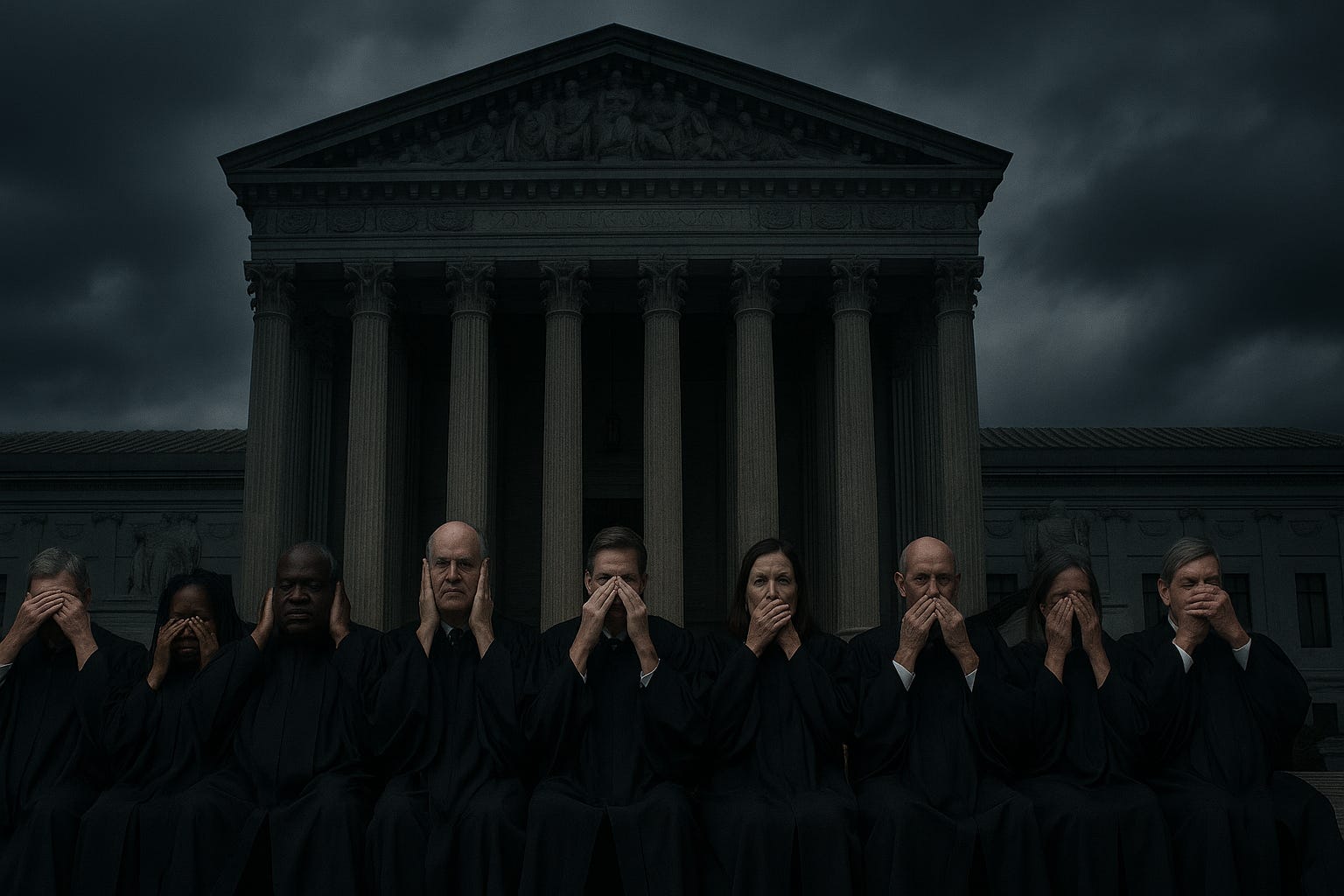
Nine months into his second term, there is no doubt but that the implicit constitution that President Trump is operating under has been changed. He has changed it. In a wide range of contexts, Trump has asserted an executive authority unmatched by any peacetime president in American history. As the Supreme Court opens its 2025 term, the single most important decision it must make is whether it will permit this amendment by executive action or whether it will resist it.
The Court has faced this choice before. In 1933, after a stunning victory over the incumbent Herbert Hoover, FDR launched the nation on a series of legislative initiatives that were plainly unconstitutional under the Court’s then-prevailing interpretation of federal power. Two years and two months after his inauguration, the Supreme Court shut it down. In a series of decisions at the end of May 1935, the Supreme Court effectively told the President that he did not have the power to amend the constitution by legislative fiat. That any such amendment would require a proposal by two-thirds of Congress and ratification by three-fourths of the states.
The President did not accept the Court’s rebuke. In an extraordinary hour-long press conference four days later, FDR gave reporters a careful and detailed rebuttal to the Supreme Court’s reasoning. The Court would return the nation, Roosevelt insisted, to a “horse-and-buggy interpretation” of federal power. Its decisions would cripple the ability of the government to address economic emergencies — which, six years into the Great Depression, the nation was clearly suffering. And then, over the next 18 months, FDR developed a subtle political strategy to rally the nation to resist the Court. Roosevelt’s speeches linked the Court to the “privileged dynasties” of concentrated economic power. His 1936 Democratic Convention acceptance speech declared that the Court had “created a new despotism and wrapped it in the robes of legal sanction.” And while he did not challenge judicial independence directly, he rallied the nation to his vision of a new “economic constitutional order.” On Election Day, 1936, the nation chose FDR over the Court, with the President winning 60.8% of the popular vote (98.5% of the electoral vote) and more than 75% of the seats in both the House and Senate. Five days after he was sworn into his second term, the President delivered his famous “Fireside Chat on the Plan for Reorganization of the Judiciary.” He declared that the nation had to “take action to save the Constitution from the Court and the Court from itself,” and he promised legislation to pack the court with justices who would support his vision of the Constitution over the “horse-and-buggy” interpretation that had blocked him two years before. Two months later, the Supreme Court signaled its capitulation: In a series of decisions beginning on May 18, the Court yielded to FDR’s reading of the constitution, fully retreating from the field of battle with the President.
Scholars have long debated whether it was the Court that had amended the Constitution by blocking FDR or whether it was FDR who had amended the Constitution by rallying the nation to affirm his new vision of federal power over the Court’s. Both sides had a good faith argument supporting their view; constitutional interpretation is hard, especially with a 150 year old document. But regardless, what’s important about this history today is that the ultimate resolution had involved every branch of the federal government — as well as the people. FDR’s constitutional vision had been expressed through laws passed by Congress; it took the Court’s resistance to frame the constitutional question for the people; and it was a ratifying election that finally affirmed that FDR’s vision would prevail. If this was an amendment to the constitution outside the procedures of Article V — as Bruce Ackerman has long argued—at least it was an amendment that Congress and the people had the chance to rally behind.
None of this can be said about the amendments to executive power that Trump has effected over the past 9 months. The president’s conception of an unprecedentedly powerful “unitary executive” has not been ratified through law by Congress. And though lower courts have resisted the changes, so far, the Supreme Court has used its shadow docket to allow these amendments to have their effect. The question the Court must now answer over the next 9 months is whether it will yield to these amendments without a fight or give the American people a clear understanding of just how radical a change the President is effecting.
As with FDR’s defenders, some will insist that Trump is simply returning us to the Constitution that the framers meant us to have. That a strong “unitary executive” was within the convention’s plan. And that it is the years of unconstitutional hindering of the executive power that Trump aims to remedy. Project 2025 explicitly invoked the original understanding of the framers of our Constitution to justify its radical rewriting of presidential authority. Their work, they insisted, was a simple rediscovery of an executive power that Madison and Hamilton would recognize as their own.
My colleague Cass Sunstein and I addressed this originalist defense to a (much more muted) “unitary executive” theory more than two decades ago. While we agreed that on pragmatic grounds, a properly translated executive authority should recognize broad powers to supervise federal policy making (though nothing like the power asserted today), the idea that the framers meant to create an executive that was anything like the conception of the modern unitarian was pure fantasy. And indeed, the unitarians today with the greatest integrity seek not to defend their conception on fabricated originalist foundations, but on a more pragmatic, Dworkinian foundation: This is the constitution America needs, so this is the constitution the Court should recognize.
We should, as a people, decide what constitution we want. We should have a process that focuses the nation on the values that it deems fundamental, and that gives us a chance to signal, one way or the other, who we are. Do we actually believe in an executive with the power to override the decisions of anyone in the executive branch? In a president with the power to dictate to the Fed the monetary policy he wants? In a president with the power to send the army into the streets of peaceful cities, demanding it seek out the “enemy within” and wage “war” against them?
Whether justices on the Supreme Court want this vision of executive power or not, they certainly realize that it is new. The Court worked hard to cabin President Biden as he addressed the crisis of COVID and climate change, blocking the actions of his executive departments four times with the wholly judge-made “major questions doctrine,” the first time just 5 months after he came to power. Before Trump, the view of the Court was that the President needed the support of Congress to launch new and important policies upon the nation. But since Trump II, the revealed view of the Court is that anything goes, so long as the ukase is signed by the President.
At the very least, the Court must frame for America a meaningful choice. And it can do that only if it makes clear to the American people just how profoundly different Trump’s vision of the presidency is. As with the Court that challenged FDR, this Court must declare these powers to be as they are — unprecedented. And it must either strike them down or explain exactly why it, the Court, is authorized to ratify — without the democratic input of either Congress or the people — such a fundamental change in our constitution’s design.
No honest interpreter of our framing document can say that the vision of executive power practiced by this president has any connection to the constitution our framers gave us. The Supreme Court should have the courage to say as much and thus give the people a chance to either rally to the president’s side or support amendments to the Constitution to vindicate his vision. What the Court cannot do is to pretend that nothing has changed or that it alone can ratify an amendment to the Constitution that has neither the support of Congress nor the American people.